Betty Blue is a film I keep returning to. I think this is the fifth time I've revisited this masterpiece of cinematography that made Beineix's name as a director in French cinema. But what is the allure? Is it the beautiful central character, Betty, whose mental condition that causes her demise keeps our eyes glued to the screen? Or is it, despite the inevitably tragic love story on show, the ordinariness, the familiarly human situations of the secondary characters and the humor between the ordinary world and a man trying to keep his dream love alive? This is no better illustrated by the old man looking through binoculars at Betty throwing the possessions out of the house in a mad strop and commenting; "There goes the ironing board... I wouldn't want a housewife like that..."

Zorg is a character to be envied. He lives in a beach house with a beautiful view, drives a truck around really fast for fun and, as he says in the opening dialogue of the film; "screws Betty every night."
But, after the first five minutes, when the "fat slob" owner comes round asking why Zorg is late for work and Betty's increasingly rude to him about it (she later pours paint over his car), we are enticed by the first crumbling foundations of this relationship and want to know where this will lead. If this didn't happen quickly, the audience would get bored and jealous or Zorg's dreamworld.
So when Betty, the wild character she is, steps onto the porch looking powerfully down at the terrified Zorg and chucks a flame-lit lantern inside the beach house, it goes up in flames along with any chance of stability in their relationship. We're incited to know how the story will further unfold.
On discovering Zorg's manuscripts, Betty is intent on typing out Zorg's novel and sending it to a publisher, yet Zorg believes that the chances of his becoming a writer are in vain. During Betty battle with the publishers to get Zorg published, they stay at the Parisian house of Betty's widowed friend who falls in love with a restaurant owner, Eddy. When Zorg and Betty get a job Eddy's restaurant we may be lulled into the idea that they could live happily like this with the nights of laughter and partying, but when Betty stabs a snobbish customer with a fork, we are reminded once again of her impatience and how she struggles to fit into the civilized world.

Betty must move on again, so, when Eddy's mother dies and they visit her house and piano shop, Eddy let's Zorg and Betty stay in his mother's house and run the shop. This third change of location adds to the allure of the film- from a beach, to the French Capital, to a rural French village, we feel as though we've traveled with Zorg on his quest for a place he can finally settle down with Betty and call home. In a way, he feels this too is a dream in his moment of narrative reflection before leaving Paris; "Betty could never stay in one place."
They meet a shop owner in this village, whose sexually frustrated wife forms a wild attraction to Zorg who has to politely let her down. Her loveless relationship with a lack of attention from the shop owner, (aptly demonstrated in her response to a row; "it takes being in love to row"), is runs parallel to Betty and Zorg's- Zorg gives Betty more than enough attention but there is something unknown, perhaps associated with her madness, that means it isn't quite enough for her, even when he takes her in a stolen yellow car to a beautiful rural house and tells her; "it is all yours."
"I get the impression Betty wants something that doesn't exist. The world's too small for her." -Zorg
The film's tragic ending wraps it up as the ultimate tale of love and loss. When Betty pokes an eye out after failing a pregnancy test, she lies in hospital surviving only on drugs the doctors feed her. And just at the time Zorg finally gets published. In a scene not too dissimilar from the unbearable emotional pain of George shooting Lennie in Of Mice and Men, Zorg must do the right thing and put her down, suffocating her to death with a pillow.
So ensues the satisfying conclusion of Zorg sat writing at the table, a published writer doing what he loves, which wouldn't have happened without the help of Betty.
That said, it isn't just the tragic tale and convincing acting that makes this film so iconic, it is the team that put it together. Director Jean-Jacques Beineix has a knack in his films for creating entertaining secondary and minor characters that stick. They all play a role and aren't merely 'sides.'

Firstly, we meet Georges, the beach worker who plays the saxophone. The tune 'Betty et Zorg' he plays is from Gabriel Yared's soundtrack for the film, the first example of how they cleverly weave in the theme music.
There's also the drugs dealer who appraoches Zorg in a restaurant toilet. Zorg uses the drugs and refuses to pay him the extortionate price he charges, saying his dreams of surfing in Hawaii with the money he wants to make from the drugs "aren't real." This is ironic considering how unreal his relationship with Betty is becoming.
Finally, the comic policemen, with which Zorg has three encounters: The first, when Zorg struggles to stop Betty running away from the street and a police car approaches them. One take his job extra seriously, diving out and pointing a gun at Zorg, whilst the other is lazy about it. The sense of bathos as Betty recovers from her fit in front of two arguing policeman is hilarious and gives such a serious film the touch humanity and reality it needs.

When Zorg gets stopped on the road for speeding when delivering a piano, he tells the policeman that Betty's pregnant and waits while he sings a song about fatherhood before sending him on his way.
In his third encounter, Zorg cross-dresses as a way of seducing a policeman before taking all their money. They are all perverted and read porn mags, which is what Zorg plays on with the cross dressing. Zorg succeeds and this heads towards the end of the film when he attempts to win Betty back from madness with the promise of "buying her an island" with the stolen cash.
Gabriel Yared's soundtrack is also what makes this film so memorable and unique. In the piano shop, Zorg plays Yared's most famous song for the film; "C'est le vent, Betty" (a line Zorg reassures Betty with when she starts hearing voices in her head.) The sounds of the chromatic, bluesy notes and slightly disjointed rhythm set the tone for a film that also manages to create beauty out of imperfection.
Premise: Zorg, a French Hanyman tries to stop his lover from going insane.
Production:
Cargo Films
Themes:
Love and Insanity
Obsession/ Attachment
Colour
Characters:
Zorg
Betty
Eddy
Lisa
Annie
Bob
Richard, the Young Policeman
The Old Policeman
The Comissaire
The Drug Dealer
The Doctor
Mario
Pizzaria Client
Mattress-hating Binman
Examples:
-Burning the House Scene
She throws stuff out of the window
Old man watches on with binoculars, make sarcastic comments
Zorg approaches Betty standing there, at the top of the stairs a lantern in hand.
She smiles devilishly at her position of insane power and authority, before throwing the lantern into the beach house and setting it on fire.
Betty and Zorg run away from this setting.
(It’s just cool and epic, like the Jack Sparrow sinking boat scene. You need your script to be daring to catch the audience’s attention, and this does so by showing the characters taking RISKS)
-Stabbing with fork scene
-Zorg breaks curtain during interview
-Binman Destroying Mattress
-Zorg plays Piano duo with Betty
The scene escalates, with the music:
It is dim, quiet, as Zorg approaches the piano. He sits, play the basic tune, then adds to it.
The camera pans to see Betty there, playing the chromatic, bluesy B-flat note. (Self-referential metaphor for how she herself is odd, bluesy, out of place and yet beautiful, harmonised by the music.)
-Yellow Car Hill Scene
-Zorg chases Betty
-Betty steals Kid
-Zorg covers his face in pasta
-Zorg Kills Betty
-The Denouement:
Brings the story to a cohesive whole; Ces’t le Vent, Betty plays throughout, Zorg looks back on photos remembering, lies on the kitchen floor, spent, writes with a few beers, the cat sat opposite him personifying Betty and encouraging him. Zorg’s true, inner goal has been achieved- to find a reason and motivation to write. He has found that reason, and must now get on with his work.
The Moon in the Gutter
Diva
There Will be Blood
A Painted House
Perfume
To Kill a Mockingbird
The Pearl
Of Mice and Men
The Lost Diary of Don Juan
The Story of my Life - Casanova
Mogadishu by Vivienne Franzmann
Oxford Playhouse, 18th February 2012
From the moment take your seat a gaze at the original set, a tall, rusty cage, you know you're in for something challenging. Luckily for me, I was able to witness one of the most provocative plays I've ever seen; one that caused an uproar from parents whose GCSE Students were studying the text.
The naturalism was so engaging I actually forgot I was sitting in a theatre and was in the midst of a battle between inner-city state-school gangs, with their regular use of 'ennit' and often comic mannerisms such as worshipping a cupcake and a delighted 'Hey Man!' to Jason's slumped character, experiencing a nervous breakdown from the guilt of his lie was racially abused by a teacher.
So interwoven and well-crafted were the characters that you could see how the kids represented their parents, e.g. Jason's over-aggressive attitude mimicking that of his Dad's.
Such was minimalism that the set could slickly transform from a playground into the Head's Office and Teacher's Kitchen.
You really got the sense of ethnic minorities and white classes labelled as two separate worlds ignoring each other, all the more the pressing because it is true: The way the Teacher always came back home for a glass of wine in her kitchen whilst the gang met up for fags (which you could smell) and to complain how much they hate 'Fuckin' Science.'
As the Teacher's socially outcast daughter contemplated suicide with a knife, holding it to her stomach, the tension was overwhelming- Not only were the deep, pulsating, sound effects and dim lighting disturbing, but the fact she was standing behind the counter so you couldn't see but imagine the blade had me on the edge of my seat.
Mogadishu is the bold spiritual equivalent of Plan B's film Ill Manors, and, like its restless youths portrayed, won't be forgotten without a fight.
Broadchurch
By Chris Chibnall
Moving, Fish out of Water Drama; A city detective who's failed a case there is called upon to redeem himself in solving a new, child murder in a close-knit Dorset town.
Reception/Reviews:
Themes: Community, Mystery
Characters: Alec Hardy, Beth Latimer, Joe Miller, DS Ellie Miller, Mark Latimer, Chloe Latimer, Danny Latimer, Liz Roper, Tom Miller, Lucy Stevens, Maggie Radcliffe, Olly Stevens, Karen White, Rev. Paul Cotes, Susan Wright, Nigel Carter, Jack Marshall, Dean Thomas, Becca Fisher, Steve Connelly, Chief Superintendent Elaine Jenkinson
Her
-Spike Jonze
A Human Story
Theme: The Misinterpretation of Love
Conflict: Emotions
Active Question: How can Theo sustain his relationship with his Operating System?
Story: Theo tries to maintain a relationship with his Operating System
First impressions from the screenplay: An original take on such a written about theme as love. The Tagline must surely come from Amy's line: "Love is a form of socially acceptable insanity" as this encapsulates the whole meaning of the film. What's stopping anyone from having a relationship with anything that gives them a purpose in life?
The ironic thing is that so many people have told me this is a 'weird' film. But, to me it's as gripping any other romantic drama. When listening to Samantha she is a real personality, (and no, not just because she's played by the irresistable Scarlett Johanson!) as love does not necessarily exist in physical form.
As Jonze said in an interview, it's not anti-technology, rather the opposite. Intellectually it can be interpreted as a dystopian exploration of the modern world's obsession with technology, but on an emotional level the film functions as a relationship drama, exploring common issues many couples must face: Past partners re-emerging and deceit which act as the major tragedy in this relationship.

Theo meets his to be ex-wife to sign the divorce papers. We know something is odd about this scene when he decides to make a plush restaurant lunch out of it and dress up formally, as though it is an occasion to celebrate. And his wife Catherine is horrible, saying "he can't deal with real human emotions" the moment he mentions his relationship with his OS. As the argument embrassingly escalates (the waitress has to back off), all the while the divorce papers lie stacked in the centre of the dining table, ominous, bold. As the scene ends of Catherine's departure, Theo begins to face one thing about his personality that he has denied all this time- He's
too nice.
12 Years a Slave
-John Ridley, Steve McQueen

Epic, Human, Fascinating, Visual
Solomon, a free negro kidnapped in Washington DC is sold into slavery and must live through years of torture with his fellow captives.
A poignant, moving film, 12 Years has the power to change anyone's perception on Slavery, or at least cast aside any misjudgments they may have held about it. A misjudgment of mine was believing the slave plantation owners even had any real sense of what they were doing to the human beings in their power. Often with dysfunctional marriages, alcoholism and problems with their personal lives, these weak bullies, in no way more intelligent, selfishly inflicted their pathetic anger and frustrations on the people they treated like scum.
This was shown with the watchful eye of reality through the true story of sexual abuse, whipping, torture and murder, a particularly horrifying incident including the terrifyingly insecure housewife, throwing a glass bottle at one of the slaves, as well as the plantation owners working them to death in the fields. Their only salvation was through song.
The minute details such as the Caterpillar eating the crop and the symbolic juxtaposition of the White House back-grounded to Solomon, our main character's cry for help when condemned to slavery was brilliantly directed by Steve McQueen. There was nothing remotely stylised or fake about its portrayal, so beat Django Unchained in this sense, despite not really having that 'entertainment' factor, but its best part was that it didn't tell us what we already knew, which is what alot of films do, and instead offered us a completely fresh perspective on an issue we know so well about, and exist's everywhere. It shed a deeply personal journey of one man's 12 years in slavery, and through its minimal dialogue and poignant, visual storytelling gave us the bare, cold reality of the horrors this experience would have struck.
Inside Llewyn Davis
-Coen Brothers
Human, Relatable
Theme:
Conflict:
Active Question:
Story:
A folk singer living in New York tries to make a living as a musician.
The power of folk music vs. the ruthlessness of the industry.
Broadchurch
Reception/Reviews:
Premise: Like a fish out of war, City Detective Alex must solve the murder of young child in a close-knit Dorset community.
Themes: Community, Mystery
Characters: Alec Hardy, Beth Latimer, Joe Miller, DS Ellie Miller, Mark Latimer, Chloe Latimer, Danny Latimer, Liz Roper, Tom Miller, Lucy Stevens, Maggie Radcliffe, Olly Stevens, Karen White, Rev. Paul Cotes, Susan Wright, Nigel Carter, Jack Marshall, Dean Thomas, Becca Fisher, Steve Connelly, Chief Superintendent Elaine Jenkinson
Stand By Me

Would you stick up for your friend if an older boy with a knife was threatening him?
Stand By Me illustrates the true meaning of loyalty and sticking together through worldly problems.
I love the conflict between the characters' inner and outer motivations- on the outside, their sole aim is to find the body of a dead man and get money for it. But deeper down, it is a quest for company, demonstrated no better than the fact they decide to leave the body despite almost dying over it, as well as their lonely, troubled backgrounds. Our main character, Gordie has lost his brother, seemingly the only friend in the world he had. But what makes this film even more relatable is the element of nostalgia. The narrative is framed by a middle-aged version of Gordie, a writer whose memory of the gang is triggered when reading that one of his friends, born-leader Chris was killed in a restaurant when standing up for another man. This narration gives the film a strong sense of realism, such as the ending when Gordie explains that these friendships disintegrated throughout school. This afterlife for the characters makes them all the more vivid in our memories as we understand that even the closest of childhoods dissolve through life's shifting tide.
Schindler's List

At three and a quarter hours long, I was cautious at the start of watching this film about whether or not it was going to keep me engaged. The fact that it did proves its worth as a classic, which, in my opinion was due to the gripping story based on historical truth, as well as the highly believable, emotionally moving acting from Liam Neeson and Ben Kingsley:
During the second world war, whilst Jews were being herded by the Nazis to labor camps, a Polish Businessman named Oskar Schindler managed to save 1,100 Jews from likely death by securing them jobs as workers in his factory.
The tension throughout the film arises from Schindler's motives to save the Jews, yet hide and mask them from the Nazi's in the name of 'industrial production.'
Schindler's good deeds are countered by the antagonist, Commander Goeth, a pathetic alcoholic who resorts to shooting Jews in the labor camp he oversees from his balcony. His relationship with Helen Hirsch ends when he discovers her love affair with Schindler, a romantic subplot that also keeps us fearing the character's lives and whether or not they will survive this terrible historical ordeal that we are so familiar with.
Do the Right Thing
The Story of Young Black New-Yorker Mookie during a ‘hot as shit’ summer during the 1980’s, and how his hometown descends into racist anarchy.
The tone of the first 5 Mins is comic and lighthearted; Mister Senor Love Daddy the radio DJ plays Rap songs and Da Mayor buys a beer form the Korean Grocery Store. We get a sense of community and ghetto setting as Spike Lee introduces the characters separately and then allows them to meet as the plot develops. The drama then escalates towards the climactic ending; Radio Raheem is killed after trying to stangle Sal at ‘Sal’s famous pizzeria. By the end, we are left simply asking; 'Could this racial war have been solved more easily?'
What interested me was how the film follows the ordinary everyday lives of the residents which are increasingly interrupted by events often associated with racial hatred; from the white man complaining about his car getting soaked to setting fire to Sal’s (ironically named) ‘Famous Pizzaria.’
The story is completely character lead, engaging the viewer with their activities and vibrant personalities. More than this, the characters are the distinguishing element; You can’t help but love them in their different ways, and it’s the fact that they’re different that gives them such charm and bold presence- This itself brings out Spike Lee’s message about communities only working when there’s an acceptance that people are different and have their own varying problems and personalities.
Goodbye Solo

A taxi driver called Solo drives an old man called William to a mountainous place where he intends to commit suicide. Solo spends a moth knowing the date he’ll take William to kill himself, the conflict bubbling as time ticks a away between the two of them and their conflicting cultures and backgrounds. Normally a happy, lively character, Solo goes quiet and subdued whenever he sees signs of William preparing to end his life, e.g. When he closes his bank account. Despite the fact that Solo asks William several times, what makes this movie so powerful is that we never know the real reason William actually kills himself. This uses the engaging notion of taking a powerful idea like this, and making it even more engaging by not directly explaining it, and leaving it up to the audience to decide.
Spoonface Steinburg
Radio Drama written by Lee Hall and produced by Kate Rowland
First broadcast in 1997 and re-broadcast on BBC Radio 4 extra 14th Jan 2014
Emotional, Moving
I loved this one hour monologue about an autistic girl faced with cancer and death. It really helped put life into perspective for me, the personal way in which a an audio play has the power to do.
Through this little, innocent girl's eyes we saw the conflict between her parents, her father's alcoholism, and all these adult issues which seem pathetic in contrast to the weight of her own problems.
But, as she says, it's the problems we have that define us. She was given the name Spoonface from the shape of her face and was always told she was different from other people. The play encapsulates how she lived with this, the imagery of life's reason being to create 'sparks' a particularly moving part of the monologue.
 Demon Brother
Writer: Matthew Broughton
Director: James Robinson
Engaging, Intriguing, Atmospheric
Gripping Radio Drama focusing on the identical twins, Jasper and his twin brother. This play was great at using sound to create tension, such as when a creature is moving in the room of his father's dead body, quite nightmarish to listen to. It is great how this is then juxtaposed with the normal atmosphere at home with the Jasper's wife, who due to his bad dreams claims to add light humour to the dark drama that he is; "entering the realm of the knobhead."
The narrator's present tense voice, in addition to the fast-paced action and atmospheric background sounds from that of a club to the whistling wind outside puts the listener in that place. I couldn't help but close my eyes and imagine the scene where he stands outside, watching his identical twin brother with his wife inside through the window- This being part of a 'game' they've planned whereby they've swapped each other's lives, an interesting, engaging dramatic concept to play with.

This is England
Realising this was such an iconic film that everyone I'd spoken to about it on my Script writing Course had seen, I thought I'd rent it from the Bournemouth University library and give it a try- and I wasn't dissapointed. In this starkly realistic exploration of life in 1980's Britain, Shane Meadows throws the ever-controversial question of English identity into our minds within the first five minutes of the film.
The opening entices the viewer with the context of 1980's Britain; images of riots, reggae, Thatcher, the Falklands, and we immediately understand the situation of our main character Shaun from the off when we see him looking at a picture of his Dad in Army Uniform. He died in the Falklands, so how's this boy going to face the challenges of living in a fatherless world? The answer; He's banned from the Newsagent's for swearing and has a fight with an older kid at school, but makes a start by making friends with a bunch of lads hanging out under a bridge.
Demanding his Mum buy him the latest pair of Doc Martins from a shoe shop rather than the cute, posh shoes is the next stage in Shaun's character development as he attempts to fit in with his new found friends.
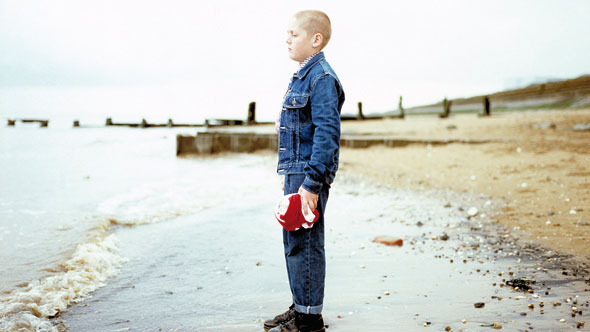
He has, as he puts it; "the best day of his life" with the gang, under-going initiation by having his head shaved and adopting their fashion style, however we expect this to take a turn for the worst when he returns home late to the ominous sound of his Mum's voice; "Shaun, come 'ere." But Meadows, ever the realist counters our expectations as the Mum visits the Gang the next morning in a cafe and claims how she's "alright with it." It beautifully demonstrates his skills as a writer in not over-complicating the story, focusing on Shaun's life and how, after his father's death he settles into English life, whatever that may be.

But events take a turn for the worst Shaun is introduced to supposed 'friends' of the gang who invite themselves to a party one night lead by the controlling, racist Combo.
The innocent Shaun becomes enshrouded in Combo's world of Nazi meetings and horrific racial attacks as he treats him like a son- an heir to his fight for the 'real England.' Yet despite his racist views, Combo opens up to Milky, a black man at the film's climax under the influence of drugs as they try to forget their problems with women. As Combo sobers up, however, he remembers his views and, with the horrified Shaun onlooking, nearly beats Milky to death.
As so Shaun is left with a question unanswered. In one of the most iconic scenes in British Film History, Shaun throws the Union Jack in the Sea and with it a question into an ocean of opinion; 'What is England?' Is it Thatcher's ideal, is it Combo's racist, Nazi patriotism, Shaun's home life with his caring mother, his shitty school life, or life in Woody's gang? Shane Meadows couldn't answer these questions, nor anyone I believe, but his ability as a filmmaker to integrate them into the lives of real people was how this film came to define a generation.
John Steinbeck-
The Pearl
 Resonates with Steinbeck’s religious, intensely observant, and traditional storytelling voice with compound sentences and a knack for demonstrating the anger of the oppressed working masses against the ignorant rich, eg: Kino’s surprise at his bloody hands after punching down the rich doctor’s gate to get him to cure his injured baby. Also, his ‘brain, red with frustration’ as he storms out of the pearl buyer’s office after they claim it has no value. Because the reader has been on-the-shoulder of Kino from the beginning, we are also tricked into believing that though the pearl may not have monetary worth, it’s value is in the bad omen and the ‘evil’ it causes, eg: When Kino hits his wife (the evil possessing him,) and of course when Coyotito’s life is taken.
He also uses the idea of creating a story with huge dramatic consequences out of something so small; ‘a pearl.’
I like the idea that the pearl had a ‘melody’ which ‘disappeared’ at the end when Kino threw it in the sea. The way Steinbeck allows the reader to interpret this sound literally, or non-literally heightens the spiritual, irrational element of the novella and establishes the ‘pearl of the world’ as an embodiment of religious, ungraspable forces which control humans through power, wealth, and all evil means.
He personifies elements of the world not usually observed such as the town of La Paz, which he describes as having an ‘energy’ of it’s own with ‘ripples’ of gossip and information passing through.
He allows reader to assume events before telling them, eg: When Kino and his wife Juano return alone, you know that the baby coyotito has been shot.
As a basic story, this novella boils down to Circe, the idea of a temptress (the pearl) tempting Kino’s family to their deadly fate, and ending with Orpheus. (The loss of their child, foreshadowed by the scorpion and it’s sting at the beginning.)
The Trial
January 2012, Cornerstone, Didcot
Blackeyed Theatre
You wouldn’t have thought at first, that with a plain backdrop, five cast members and several wooden frames dotted about the stage that much could have been done in the way of a professional performance- Blackeyed theatre proved this a complete misconception; Their creativity and inventiveness in the use of physical theatre kept Kafka’s existentialist masterpiece about the oppression of the law courts and higher authorities alive, and it was this originality which staved off any real need in the way of representational props, set or costume. All the techniques used were aimed at creating this atmosphere of false uniformity and rigidity to mock K’s trial under the controlling powers he wrongly maintained trust in.
As in Berkoff’s adaptation, the characters were heavily stylised to convey the ridiculousness and lack of responsibility amongst those in power. The non-naturalism here allowed the actors to multi-role a variety of characters, but usually according to their relative status and characteristics; the physically tall actor for example both sauntered onto the stage as the smarmy-voiced Inspector and later lay uncaringly in his box as Huld, two characters who equally represent the uselessness and irresponsibility of management. I also loved the idea of having only one actress playing all the female roles, as it became coherent with Kafka’s message regarding such an elite, highly-censored society; that all women in it are the same, using their evil, seductive nature to have some feeble form of control in such a male-dominated society. This idea was evident in the scene where Leni, Huld’s seductive assistant kisses the awkward K, who replies in innocent surprise; “Oh. You’ve kissed me!” I found K’s character particularly similar to the one I initially had in mind; selfish, egotistical in nature with an innocently assuming facial expression and upright posture as the inhuman, gremlin-like guards almost comically scuttled in and searched his apartment. This revealed the most telling quality of his character- That he was content with his formal, safe and secure life and therefore confused and questioning of his trial.
The sheer amount of effort and perfection of timing gone into the ensemble’s use of rigid, uniform voice and choreographed movement was simply impeccable, and this was made greater by the fact that the cast was present on stage all the time, always acting and systematically reacting to all the actions centre stage. I was nearly hypnotised by their mimicking of typewriters in the office in synchronising their hand movements and vocal beats, and the way the two guards lent back and forth, clicking their tongues simultaneously to create the impression of a grandfather clock- this was physical theatre at its best. I found their use of two connected doorframes as a coffin-like bed for K suggestive of this entrapment K cannot escape from. As he woke up from it in the morning, members of the chorus bobbed up and down from behind other doorframes (presumably other apartment windows,) repetitively calling out Joseph K’s name and other comments on his trial. I got a strong sense here of a society mindlessly following orders as cogs in a machine, reflecting on Kafka’s existentialist theme through stylistic physicalisation and often satryical humour. During the suggestive scenes as K falls into the trap of his seductive women, the chorus wailed in anticipation, then comically groaned in disappointment when K reeled back in a socially awkward fashion.
The use of blue lighting in the final scene, where the priest assures K he has failed in his trial, along with the fact the priest was physically raised above K provided a heightened conclusion to the performance which was unforgettable. Unlike Berkoff’s original, they put the aphorism about the successive line of hierarchical doorkeepers at the end as opposed to the beginning, a decision I thought worked as it made the conclusion seem more empowering and abstract in contrast to the deliberately mundane introduction to K’s circumstances. Green lighting was used to great effect in the unit of the play portraying K’s nightmare; Not only did the visual element of the chorus surrounding K’s body and muttering disturbingly draw my attention, but the subtle addition of the woman’s moaning singing voice made this the most horrific and powerful scene for me, as though the audience were part of this nightmare too.
So with it’s faultless physical theatre, precise timing in the movement of the ensemble as they mocked the confused K, and the heavily Brechtian and stylised representation of social archetypes, Blackeyed theatre shrugged off any doubt that Kafka’s existentialist message and Berkoff’s minimalist interpretation might not be timeless.
The Hothouse by Harold Pinter
Oxford Playhouse 4th February 2012
Illyria Productions
With its darkly comic moments teetering on the fine, sensitive line between laughter and sheer shock, the student company, Illyria Productions, certainly stayed true to Pinter’s ability to play with the audience’s reactions.

The obvious thing that struck me as I entered the auditorium was the subtly symbolic use of space: There were two halves to the stage- Stage left was set out as the client’s room, while stage right, the boss’ office, was deliberately higher up to create a physical sense of hierarchy. This adhered to one of the play’s central ideas; the irresponsibility and mindless abuse from those at the top of the organisation. The term ‘organisation’ used loosely, it is clear that both Pinter’s and Illyria’s intentions for setting were timeless, as if to represent the universal nature of its authoritarian themes, and nothing showed this better than the use of TVs with security camera images- an original idea where the actors could be seen going up the stairs before entering the office. This not only induced a nervous atmosphere of cold anticipation, but the dramatic irony created by the characters on stage not knowing when someone’s walking up the stairs with a gun also contributed to the tense heartlessness of the institution.
The gullible, innocent nature of the tortured patient epitomised the comedy in ‘dark comedy.’ This was evident in his attempts to create happy, light conversation; “I’m willing to answer any questions you may have,” whilst his torturers circled the electric chair he was strapped to. Indeed, his nervous laughter and broken state of mind showed parallels with the character Stanley Webber in another famous Pinter play; The Birthday Party. Other characters that helped define this darkly comic atmosphere include the boss and his ignorance to the horrific situations being allowed to fester within his organisation of ‘care:’ He regularly complained about how “hard” his day to day work in the office was, when in fact he simply spent his time abusing patients, drinking heavily, and complaining about the heating being on “too hot.” Another hilarious example of this was the boss’ short term memory-loss due to being heavily caught up in always talking about himself, and the way he blamed everyone else for everything that went wrong. Finally, the way another higher member staff had the habit of repeating in his monotone voice; “The snow’s turned to slush,” perfectly illustrated the comedy of the situation, yet also provided an agonising reminder of the pointless and power-hungry position of those in charge.
The climatic ending to the production delivered another of Pinter’s messages as to how easily authoritarian rules such as this are over-powered by the majority: When all the patients, who are not seen, supposedly kill the members of the hierarchy through the shouting and screams heard off-stage, they use lighting to highlight the patient numbers plastered across the stage in blood, the horrific conclusion to the play further heightened by the sound of murder increasing in volume. A comic yet darkly truthful production that sent the audience on a roller-coaster ride of emotion.
'Tis Pity She's a Whore by John Ford
11th February 2012, Oxford Playhouse
Cheek by Jowl
To begin on a negative, it appears Cheek by Jowl have ignored any warnings illustrated so well in Peter Brook's writings on Deadly Theatre- Don't perform a play just nostalgically glorify dated language, as is done in so many Modern interpretations of Renaissance plays. The non-verbal opening was brilliant, the Sister lying on her bed with headphones and laptop was brilliantly naturalistic, until she opened her mouth and started Ford's verse. Why they, presumably, speak Renaissance English in modern day Parma is beyond me; they must be a very shut off society...
Still, I loved their recurring religious motifs of incest such as the ominous sound of the church chorus during Giovanni and Annabella's love-making, whilst her suitor's creepily stared at her from across the room. They certainly got across a sense of guilt and drama of a Romeo and Juliet standard.
The fact that the play was set entirely in the girl's room made for a very intimate and therefore dramatic performance, whilst the recurring use of red (lighting, wall colour, lip-stick, hoodie) seemed to draw out the contrasting tension between love and evil.
Mogadishu by Vivienne Franzmann
Oxford Playhouse, 18th February 2012

From the moment take your seat a gaze at the original set, a tall, rusty cage, you know you're in for something challenging. Luckily for me, I was able to witness one of the most provocative plays I've ever seen; one that caused an uproar from parents whose GCSE Students were studying the text.
The naturalism was so engaging I actually forgot I was sitting in a theatre and was in the midst of a battle between inner-city state-school gangs, with their regular use of 'ennit' and often comic mannerisms such as worshipping a cupcake and a delighted 'Hey Man!' to Jason's slumped character, experiencing a nervous breakdown from the guilt of his lie was racially abused by a teacher.
So interwoven and well-crafted were the characters that you could see how the kids represented their parents, e.g. Jason's over-aggressive attitude mimicking that of his Dad's.
Such was minimalism that the set could slickly transform from a playground into the Head's Office and Teacher's Kitchen.
You really got the sense of ethnic minorities and white classes labelled as two separate worlds ignoring each other, all the more the pressing because it is true: The way the Teacher always came back home for a glass of wine in her kitchen whilst the gang met up for fags (which you could smell) and to complain how much they hate 'Fuckin' Science.'
As the Teacher's socially outcast daughter contemplated suicide with a knife, holding it to her stomach, the tension was overwhelming- Not only were the deep, pulsating, sound effects and dim lighting disturbing, but the fact she was standing behind the counter so you couldn't see but imagine the blade had me on the edge of my seat.
Mogadishu is the bold spiritual equivalent of Plan B's film Ill Manors, and, like its restless youths portrayed, won't be forgotten without a fight.
Proof by David Auburn
Bournemouth Little Theatre, Winton
25th October 2014

The fact that the audience was just a sea of white heads as this vibrant play drew to a close was a depressing one. The sheer energy and drama I witnessed tonight was above and beyond most plays I've seen before.
Bournemouth Little Theatre's 100th Anniversary is approaching in five years, and this production suggests they're already getting ready for it.
I'll begin with the Script and Story; A deceased Mathematical Genius' (Robert) daughter (Catherine) must prove to her boyfriend (Hal) and sister (Claire) that she wrote a ground-breaking formula in a notebook written in the style of her father's handwriting whilst trying to emotionally move on.
Instead of addressing this premise with some mathematically-referential plot about a woman trying to prove her equation, the writer focuses instead on the underlying conflict between our main character and the people closest to her in the aftermath of her father's death; The fact that the materialistic, bread-winning Claire has a hidden jealousy for Catherine for inheriting most of her Dad's talent, Hal's idolisation of Robert clouding his love and respect for Catherine, and of course her Dad...
It is a good sign when, only
after the audience build an emotional connection with Robert in the opening scene, are they drip fed the information by him that he is Catherine's hallucination; "I can't help anymore Catherine, I'm actually dead...." Robert is a funny, encouraging character with a bagful of quirks; "I hate pasta... It sounds like surrender" so the inevitable conflict here is that Catherine must learn to move on.
Whilst trying to prove that, as Hal reminds Catherine, "you are not the same, you are better than your Dad," she must try and fill the hole left behind by her family loss. Something a younger audience, as well as just a group of middle class elderly people can relate to.
The acting was completely engaging and believable from this close, tight-knit cast. Not one moment was over-acted, and the props were minimal; a bottle of wine/champagne here and there, a beer, Hal's nerdy collage bag with drumsticks. Our interest was drawn to the developing relationships between these characters; Catherine and Hal's love affair, Catherine and Claire's bitchy fights about moving onto to a materialistic, glossy New York world, and not forgetting actor Stewart Barlow's fire and enthusiasm as he became possessed by Robert's mathematically insane character, forcing her daughter to read one of his algebraic equations out in the blistering, wintery Chicago cold.
What passed along this little, intimate stage tonight was more than just a gripping production of an emotional roller-coaster of a script. It was Proof that Bournemouth Little Theatre is bound to reach much further than its 100th Anniversary.
Action Reaction
Short film by Mo Hines:
Emotional, Human
This short set in LA portrays the tensions of gun crime, racism and inequality in the city and how these impact on love and relationships. Whilst it could have been shorter, (there was far too much long, drawn out dialogue), the tensions in both relationships played out with powerful emotional effect. As the pregnant woman's boyfriend wrestled on the floor with her racist brother who had been sent by a gang to shoot him due to his race, what I found most compelling was the relationship between the Chubby man and his younger, more attractive girlfriend. The question he kept putting to her was; "Why are you with me?" and this was the active question that made this relationship more interesting than the other. It's resolution is interesting too- she does love him, but the moment she accept his marriage proposal she gets hit by a gunshot, although how the gunshot reached her from the other room remained vague and unclear.


